
Sunday Knight Factory Guide
A working brief for brand owners, retailers, and club buyers who want acrylic tiles, racks, and a matching case — not a catalog page dressed up as advice.
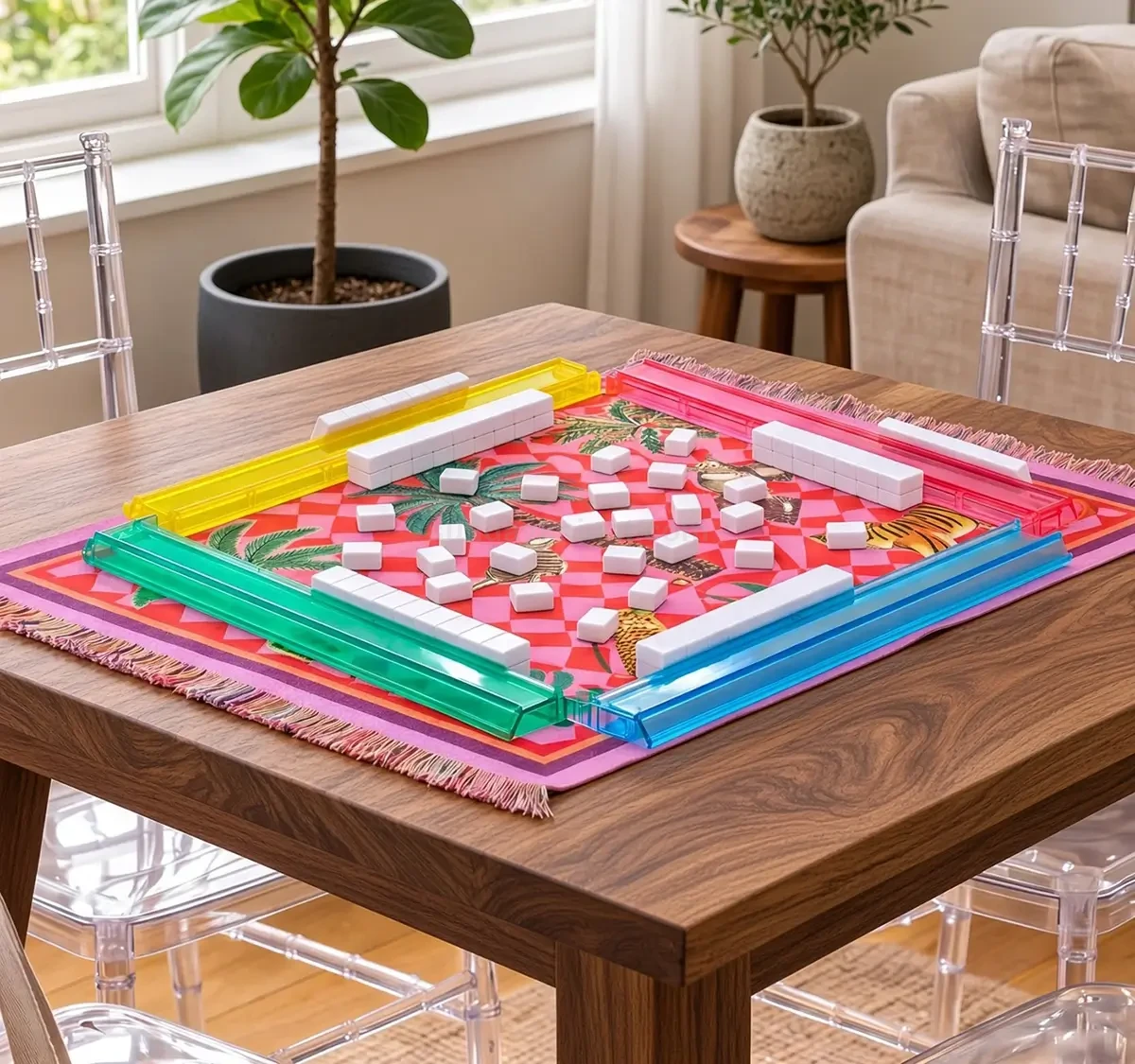
Sunday Knight has cut, polished, printed, and assembled acrylic in Dongguan since 2012. Most of that work is still displays, boxes, and trays. Mahjong arrived the same way a lot of our work does: a buyer needed racks that actually fit their tiles, then a case that fit the racks, then tiles that matched the color story of the rest of the brand.
This page is the conversation we have after that first email. It is written so you can brief a factory without guessing, and so you can tell whether we are the right shop before anyone mills a blank.
Why acrylic, and why it is not “just plastic”
Players compare tiles with their hands before they compare them with a spec sheet. Bone and bamboo still have a following. Melamine is cheap and light. Injection-molded plastic is fast. Cast acrylic sits in a different place.
A cast PMMA tile keeps its size in humid rooms. The face takes a clean engraved line. Color can be matched to a Pantone chip instead of hoped for from a resin batch. The piece has weight — not bone weight, but enough that it does not skate across the table when someone reaches for tea.
We use virgin cast sheet, the same family of material we specify for high-clarity boxes. Grades cover standard indoor sheet, UV-stable sheet if the set will live near a window, and impact-modified sheet when a club wants something that survives a drop. Finishes run from high-gloss polish to a soft matte that hides fingerprints.
Tile size: three numbers that decide the rest

Chinese factories often name a tile by height alone — “size 32,” “size 36.” American retail listings often give inches and stop there. Neither habit is enough for production.
Write the tile as height × width × thickness, in millimeters, measured the same way every time: standing the tile as a player sees it. Then say how you measured (calipers on the face, not a tape across a stack) and what you will accept as a batch range.
| Planning size | H × W × T | Inches, rounded | Where it usually goes |
|---|---|---|---|
| Compact | 30 × 23 × 13 mm | 1.18 × 0.91 × 0.51 in | Travel sets, tighter racks, smaller cases |
| Mid | 32 × 23 × 13 mm | 1.26 × 0.91 × 0.51 in | Common American retail band; extra face for artwork |
| American club | ~38 × 28 × 18 mm (1.5 × 1.1 × 0.7 in) |
1.5 × 1.1 × 0.7 in | Heavier table feel; confirm rack channel before you lock it |
| Full / mainland style | 36 × 25 × 15 mm | 1.42 × 0.98 × 0.59 in | Taller face, thicker body, often played without racks |
Those four rows are planning points, not a law. A brand that already sells a 1.5-inch tile should send one physical piece or a measured drawing. We will match that piece, not a blog table.
Size changes four other things at once:
- Artwork room. A 36 × 25 mm face has roughly a third more printable area than a 30 × 23 mm face. Dense floral work that looks generous on the larger tile will crowd the smaller one.
- Rack fit. Width sets how many tiles sit in a row before the pusher binds. Thickness sets whether the tile sits or rocks in the channel.
- Case and bag. Two millimeters of extra height across 160 tiles is a different insert.
- Weight and freight. Cast acrylic is about 1.2 g/cm³. A compact blank is near 11 g; a full-size blank is closer to 16 g. Multiply by the tile count, then add racks and a case, before you promise a ship weight.
American sets vs. Chinese sets
The rules change the packing list. They do not change how acrylic is cut. Still, mixing the two lists is how a first order goes wrong.
American table
Most brand programs we see want 160 tiles: suits, winds, dragons, flowers, jokers, and a few blanks. Some ship 166 and keep extras in the case. Faces are usually English-marked (E / S / W / N, Red / Green / White dragons) so a new player can sit down without a chart. Racks with pushers are expected, not optional.
Chinese / club table
Tile count is commonly 144, sometimes with extra flowers. Faces stay in traditional characters. Many tables play without racks, so the tile has to stand in a wall and take a knock without skating. Thickness and edge radius matter more than pusher magnets.
If you sell both, treat them as two SKUs. Do not stretch one mold and hope the accessory list follows.
One piece or four layers

Two constructions cover most of the work we do.
Monolithic. One piece of sheet, engraved and filled or UV-printed on the face, sometimes printed on the back. Fewer bond lines. Easier to keep thickness even across a 160-piece run. Good when the look is “a solid tile,” ivory or black or a single tint.
Laminated. Two, three, or four sheets stacked: a clear face, a printed or colored core, a backer. This is how tortoise, candy tint, glitter cores, and a thin decorative band get inside the tile instead of sitting on top of it. It is also how you pick up small voids or a visible glue line if the process is rushed. We inspect the edge under light before a batch leaves the bench.
Layer count and finished thickness are separate numbers. A four-layer tile can still be 13 mm. Say both.
Engraving, paint, and UV print
Markings have to stay readable after a season of thumbs. The three routes we use most:
- Engrave and fill. The line is cut into the face, then color is laid in. The mark has a slight depth you can feel. Good for classic BAM / CRACK / DOT work and for logos that should look carved, not stickered.
- Engrave and UV. The cut gives registration; UV ink gives color range. Useful when a brand wants a painted look without a thick fill that can chip at the rim.
- Direct UV on the face or under a clear cap. Fast for full-bleed art, photographs, and seasonal drops. On a wear surface we prefer the art under a clear layer so the image is not the thing that rubs.
Send vector files for line work (AI or PDF with fonts outlined). Photos need a print-ready size at the actual face, not a screenshot from a mood board. We will tell you if a line is too thin for the chosen size before we cut a full set.
What you can actually change

Buyers usually arrive with a color and a logo. The list is longer than that, and some items move the price more than others.
| You can specify | What we need from you |
|---|---|
| Body color and finish | Pantone or a physical swatch; gloss / matte / frost / tint / tortoise / glitter core |
| Tile size and edge | H × W × T in mm, corner radius or chamfer, sharp vs. softened rim |
| Layer stack | How many sheets, which one carries the art, finished thickness |
| Faces, backs, edges | Standard American or Chinese markings, monogram, pattern, full illustration |
| Racks and pushers | Length, channel, magnet count, color to match or contrast the tiles |
| Case, bag, insert | Hard case, sliding-lid acrylic box, soft bag; foam or tray insert drawn to the tile |

Themed tiles — holiday, sport, pet, coastal — are the same process as a brand set. The art is the variable. We would rather redraw a motif so it engraves cleanly than force a painting onto a face that cannot hold it.
Racks and pushers — the part players notice first

This is the product we already list on the site, and it is usually how a mahjong conversation starts with us. A pretty tile in a sloppy rack still feels cheap. A plain tile in a rack that seats and slides correctly feels finished.
What we lock on a rack drawing:
- Overall length. American tables often sit in the 17.5–20 inch range. Confirm the table, not the internet average.
- Channel width and depth against the actual tile, with a little clearance so humidity and polish do not pinch the row.
- Pusher style: scalloped slide (the SKOT-style bar with a small screw), friction, or a magnet bar. Hardware needs a pocket that does not telegraph through a thin wall.
- Color: clear, tint, tortoise, or a match to the tile back. Tortoise is layered sheet; small surface movement in the pattern is the material, not a defect, and we say that in the spec so retail teams are not surprised.
If you already sell tiles from another shop, send one tile. We will cut the rack to that tile. Guessing from a product-page inch mark is how a first container comes back.
A full set is seven line items

A “set” on a product page hides the bill of materials. On the quote it looks more like this:
- Tiles (144 / 160 / 166, construction and marking as above)
- Four racks and four pushers
- Dice — usually stock; custom dice are a different tool
- Wind indicator, if the rules need one
- Play mat, often sourced, sized to the table you sell
- Tile bag or hard case with an insert cut to the tile
- Outer carton and any retail sleeve or gift box
You can launch on tiles and racks and add the case in a second drop. You should not launch on tiles and then discover the case you already printed does not close.
How an order runs on our floor

Sunday Knight is one workshop, about 4,000 m², working to a ±0.2 mm CNC tolerance on the parts that need it. Mahjong does not leave the building for a second vendor to “do the polish.” That is the point of keeping displays and game parts on the same floor — a lid groove and a rack channel are the same kind of problem.
The commercial path is the one on our How to Order page. On the floor, after a sample is signed, it looks like this:
- Drawing lock. Outside vs. inside, channel, magnet pocket, print-safe zone.
- Sheet named on the job ticket — grade and color, not “acrylic.”
- Cut, engrave or print, polish, bond if laminated, fit hardware.
- Piece inspection, then pack.
Sample tiles can be turned in a handful of working days when the art is ready. A full pre-production set takes longer because it is really a small production run. Bulk after approval is commonly 10–20 working days; layered color, special sheet, or a peak export week can run 20–30. The date is written on the quote before the deposit, not invented at the dock.
Standard factory minimum on most of our acrylic work is 100 pieces per design. Game programs are quoted by the set. We would rather confirm a number against your construction than publish a fake one that only applies to the easiest version.
What to send so the quote is usable
A photo of a competitor’s set is a starting point. It is not a brief. Send as much of the list below as you have. Missing items get assumptions, and assumptions show up in the sample.
- Play format: American or Chinese, and the exact tile count.
- Tile size as H × W × T in mm, plus corner treatment.
- Construction: solid or layered; target weight if you have one.
- Colors: Pantone, or a physical chip we can put under the same light as the sheet.
- Artwork: vector for line, print-ready for full face; say what sits on the front, back, and edge.
- Rack length and a note on magnets. Or a rack you already sell.
- Which accessories ship in version one.
- Where the carton has to land, and whether you need DDP.
Email sales@sundayknight.com or WhatsApp +86 134 3456 8211. Factory hours are Monday–Saturday, 08:00–20:00, GMT+8. We answer a complete brief in 1–8 hours. An incomplete one takes longer because we write back with the gaps instead of inventing them.
Questions we get before the first sample
Do you only make racks, or the tiles as well?
Both. Racks and pushers are already on the site because that is the part buyers asked for first. Tiles, cases, and the rest of the bundle are the same acrylic work — different drawing, same machines.
Can you match a tile we already sell?
Yes, if you send a piece or a measured drawing. Matching a lifestyle photo is how batches drift.
Will the color look like the chip on every tile?
On dyed or tinted sheet, we can get very close. Layered patterns such as tortoise will move slightly from piece to piece. That movement should be written into the retail copy so a customer does not treat it as a reject.
Who owns the art and the tool files?
Your artwork stays yours. We sign an NDA when a buyer needs one. Molds and jigs built for your part are used for your part.
Can I order one set?
A single retail set is not how this floor is set up. Sampling is built for approval. Production is built for a design run. If you need one boxed set for a photo shoot, say so — that is a sample, priced as a sample.
What travels with the tiles?
Whatever you put on the packing list. We do not quietly add a mat or a rule booklet and then wonder why the carton weight changed.
Send the three numbers and a sketch
Height, width, thickness. A note on American or Chinese. A rough idea of color. That is enough for a first reply. If you already have a rack or a case in market, send that too — we would rather fit work you have than redraw a table that already exists.
Or write sales@sundayknight.com · WhatsApp +86 134 3456 8211
 English
  Deutsch
  Français
  Italiano
  Español
  Nederlands
  한국어
한국어